Why Your Nose Blocks the Second Your Head Hits the Pillow
Fine all day. Blocked by midnight. Awake at 3 a.m. with your mouth hanging open. There's a simple physical reason, and once you see it, you'll understand why nothing you've tried at 3 a.m. has ever stuck.
In this article, you'll discover:
- The "Pillow Effect": what happens inside your nose the moment you lie down (and why it isn't your fault)
- Why you keep flipping from side to side at night just to clear one nostril
- Why "just one quick spray" so often turns into a nightly habit that people joke about but don't find funny
- The 15-minute, drug-free wind-down people are doing sitting up, before bed, to get ahead of the night instead of fighting it at 3 a.m.
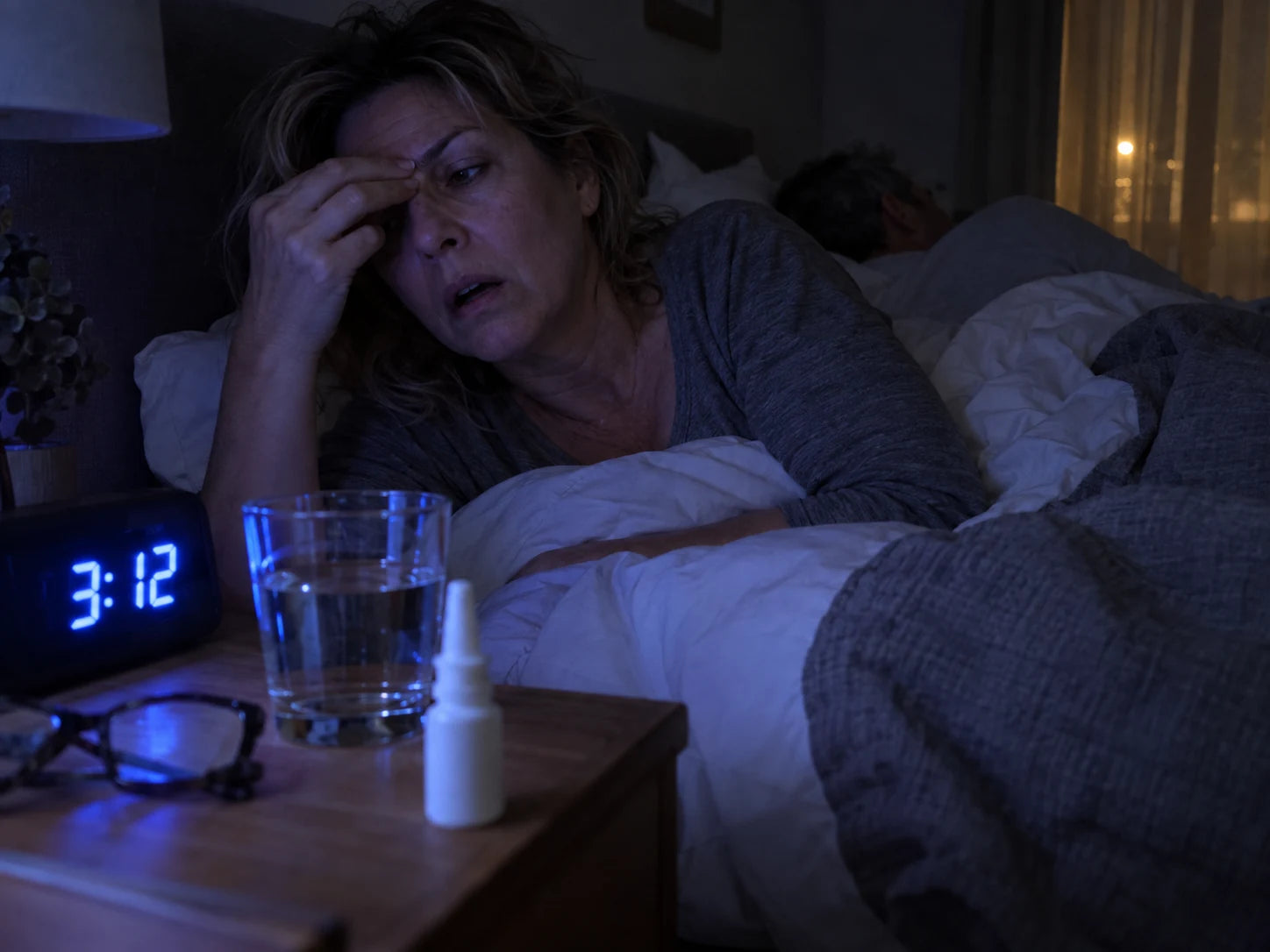
It's 3:12 a.m.
You're awake again. Not because of a noise, and not because of a bad dream.
Because you can't breathe.
Your mouth is hanging open. Your throat feels like sandpaper. One nostril is completely shut, and the other lets through about as much air as a coffee stirrer.
So you roll onto your other side. You wait. You roll back. Maybe you sit up for a minute and stare at the wall.
And somewhere in there, your hand is already drifting toward the nightstand. Toward the little spray bottle, or the box of strips, or the glass of water for your sandpaper throat.
If that sounds familiar, you're in large company. On the Mayo Clinic's patient forum, one person wrote that their congestion makes them "wake up over ten times a night." Another described the "air hunger in the middle of the night." Someone on a UK health forum put it in a dozen words most of us could have written ourselves:
"every night I wake up around 3-4 am and that is it."
And if you share a bed, it isn't only your night that suffers. The shifting, the sniffing, the mouth-breathing: the person next to you hears all of it. One reader wrote to the Harvard Health Blog: "The gasp is so loud that it makes my husband nervous."
Then comes the next day. The dry throat. The heavy head. The coffee that doesn't quite reach. One Mayo Clinic forum member described living with "drowsiness, slowness of thought processes, and general brain fog." It's hard to be sharp at work, or patient at home, on a night of broken sleep. Harder still when it's every night.
Here's the part that makes it so maddening, though.
All day long, you were fine.
You breathed through your nose at your desk. In the car. Through dinner. Maybe a little stuffy here and there, nothing serious.
Then you lay down. And within minutes, your nose shut like a door.
Has anyone ever explained why that happens?
Probably not. Most people with this problem get handed another spray and sent on their way. Nobody sits them down and says, "Here's what's actually going on inside your nose at night."
So let's do that now.
Why "Everything" Hasn't Worked
If you've dealt with this for a while, you've likely built up a small pharmacy. One poster on a sports forum listed theirs: "Zyrtec, Claritin, Sudafed, Flonase, Nasacort. Nothing seems to help."
Here's why that list keeps growing.
Steroid sprays. For some people they help. For a lot of people, they fade. You'll see the same sentence over and over in reviews: "The generic fluticasone worked for a while." Others say the sprays irritate their nose or give them nosebleeds.
Saline rinses and neti pots. Some people swear by them. Others describe the experience as "burning like the seven hells," and one Mayo Clinic forum member rated it a "50-50 chance of clearing the nose." That's not great odds at 3 a.m.
Nasal strips. They pull your nostrils open from the outside. But the blockage you feel at night is inside, deeper in the nose. So strips often become a crutch rather than a fix: "my only solution is to use Breath Right strips nightly."
Decongestant pills. In 2023, an FDA advisory panel concluded that oral phenylephrine, the decongestant in many pills on the open shelf, doesn't work as a nasal decongestant. The stronger kind kept behind the pharmacy counter works for some people, but it can keep you wide awake. One reviewer summed up the choice: "It's a trade off, sleep against painful sinuses."
Notice what every one of these has in common.
They all go after the congestion once it's already there.
Not one of them answers the question you've probably asked yourself a hundred times while staring at the ceiling:
Why is it so much worse the moment I lie down?
The Pillow Effect: What Happens Inside Your Nose When You Lie Down
When we started reading forum threads and reviews from people stuck with nighttime congestion, the same pattern showed up again and again.
Fine all day. Blocked at bedtime. Flipping sides all night. Awake at 3 a.m., breathing through the mouth.
It turns out there's a well-documented physical reason for it. We call it the Pillow Effect.
Here's how it works, in plain English.
Inside your nose are soft ridges of tissue called turbinates. They're packed with tiny blood vessels, and they behave a lot like a sponge.
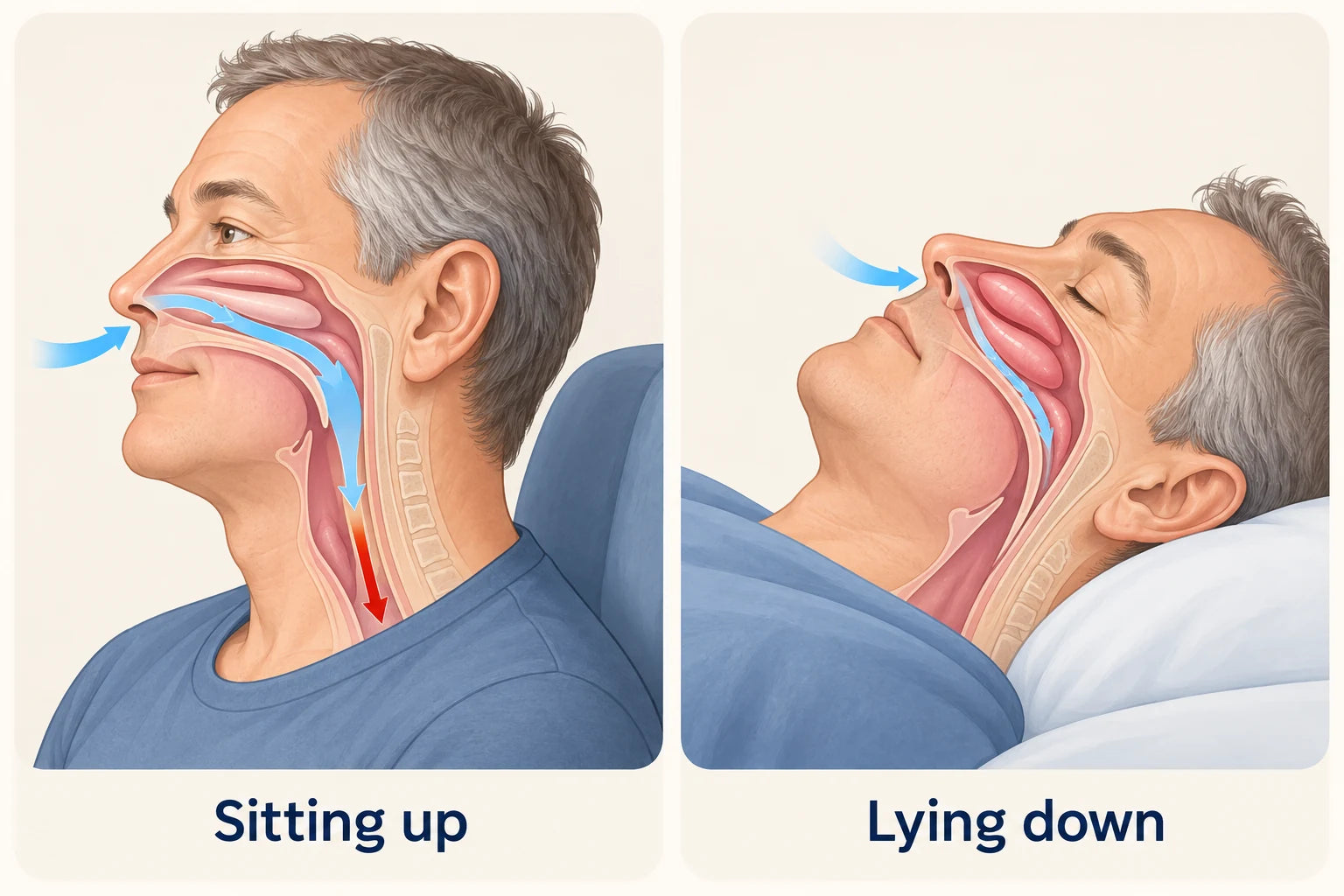
When you're upright, gravity helps blood drain away from your head. The sponge stays fairly slim, and air moves through easily.
When you lie down, your head drops to the same level as your heart. Gravity stops helping. Pressure in the veins of your head rises. By some researchers' estimates, it more than doubles compared with standing.
So the sponge does what sponges do. It soaks up. It swells. And the passage that felt fine an hour ago narrows until it feels completely blocked.
Think of it like traffic. Standing up, the lanes in your nose flow. Lie down, and every lane jams at once.
This is also why you keep flipping sides.
When you lie on your side, the tissue in your lower nostril swells the most. So the bottom side blocks, you roll over, the other side slowly opens up... and then the new bottom side starts to close. One Mayo Clinic forum member noticed it on their own: they kept waking after rolling onto their back, and rolling onto their side gradually cleared the upper nostril.
If you've ever done the nightly nostril shuffle, now you know why. Your body isn't broken. It's physics.
To be clear: the Pillow Effect doesn't replace whatever sets your nose off in the first place. Allergies, dust in the bedding, dry winter air, a cold: those are real, and worth talking to your doctor about. The Pillow Effect is why all of it gets so much worse at night.
And once you see it, something else starts to make sense too.
Why the Spray Has to Win the Same Fight Every Single Night
Let's talk about the bottle on the nightstand.
Decongestant sprays like Afrin (oxymetazoline) work fast, and they work well. They squeeze the swollen blood vessels in your nose, the sponge shrinks, and within minutes you can breathe.
That's why people love them. As one longtime user put it:
"It's not like I'm getting high off it. I just enjoy breathing..."
But think about what the spray doesn't change.
It doesn't change gravity. Tomorrow night you'll lie down again, the Pillow Effect will kick in again, and the sponge will swell again. So you'll need the spray again.
And that's where the trap closes.
Look at the label on a decongestant spray. It says not to use it for more than 3 days. Past that point, many people develop what doctors call rebound congestion: when the spray wears off, the nose swells back up, often worse than before. So you spray again. And again.
It's a bit like a payday loan for your nose. Instant relief tonight, with interest due tomorrow night. Rebound congestion is the interest.
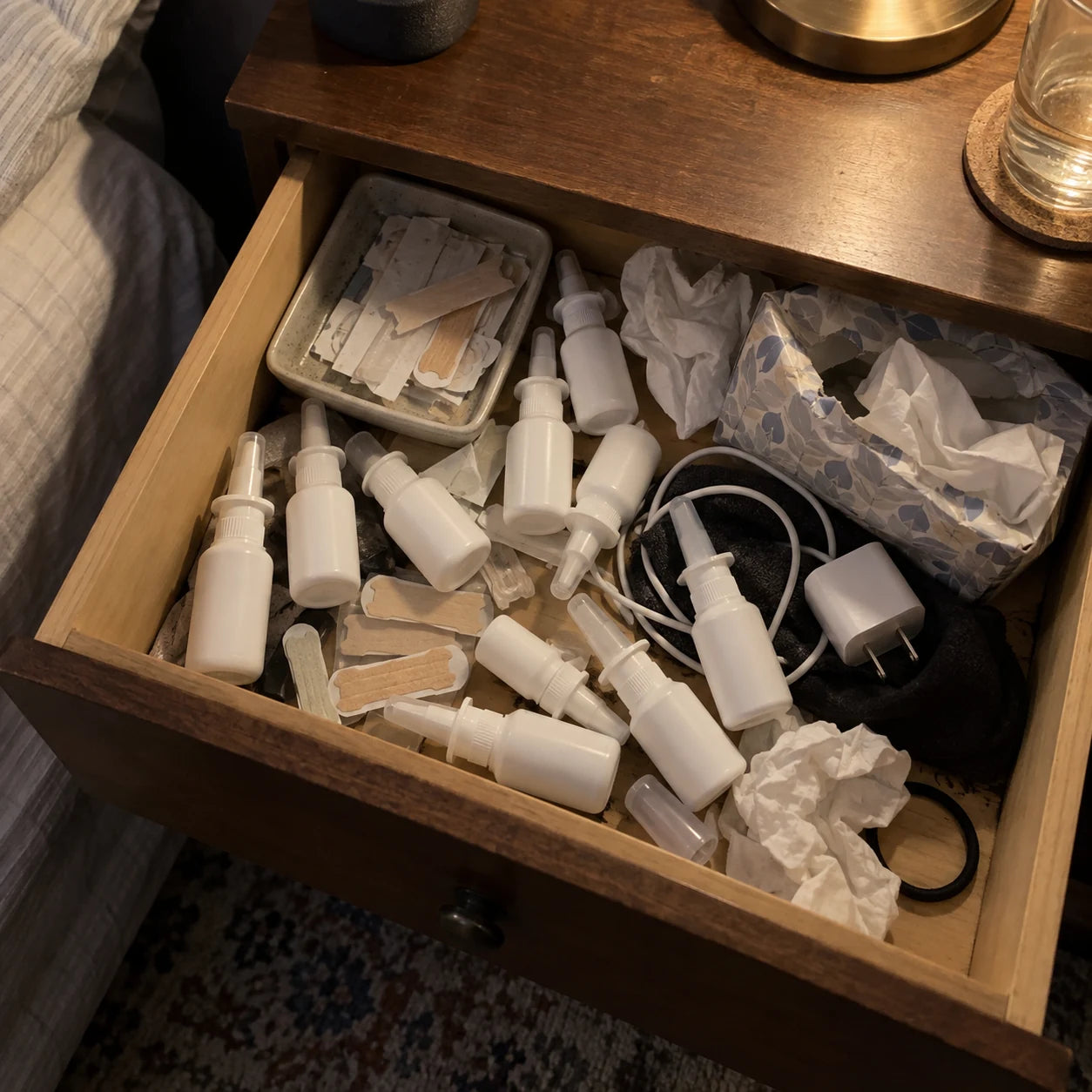
Plenty of people who got caught in it talk about it with a dark sense of humor:
"I've been a nose spray junkie for @ 40 years."
"I should own stock in Afrin"
The humor fades when they try to stop. One person who quit after more than ten years wrote: "My first 4 days were nothing but hell on earth."
If any of this is you, hear this clearly: you didn't do anything stupid. You found the one thing that let you sleep, and you used it. Anyone would. For many people, it's "the only time I get a good night's sleep."
The problem was never you. The problem is that the spray fights the Pillow Effect after it has already started, every single night, and borrows against tomorrow to do it.
(If you use a decongestant spray regularly, it's worth talking to your doctor or pharmacist about it. Nothing in this article is a substitute for their advice.)
So What Actually Changes the Night?
Put the two pieces together:
- Your nose closes at night for a physical reason: the Pillow Effect kicks in the moment you lie down.
- Fighting it after it starts, with a spray at 3 a.m., has to be repeated every night, and can make the nights harder over time.
So maybe the fight is happening at the wrong time.
Stuffy nights are won or lost before your head hits the pillow.
Instead of waiting for your nose to close and then reaching for a chemical, what if you got ahead of the night? A calm, drug-free wind-down while you're still sitting up, followed by a simple change to how you sleep?
That's the idea behind the Warm Wind-Down Method. It takes about 15 minutes on the couch or propped up in bed, and it's built around something people have trusted on their noses for well over a century...
The Strange Blue Lamp That Sat in Millions of Homes
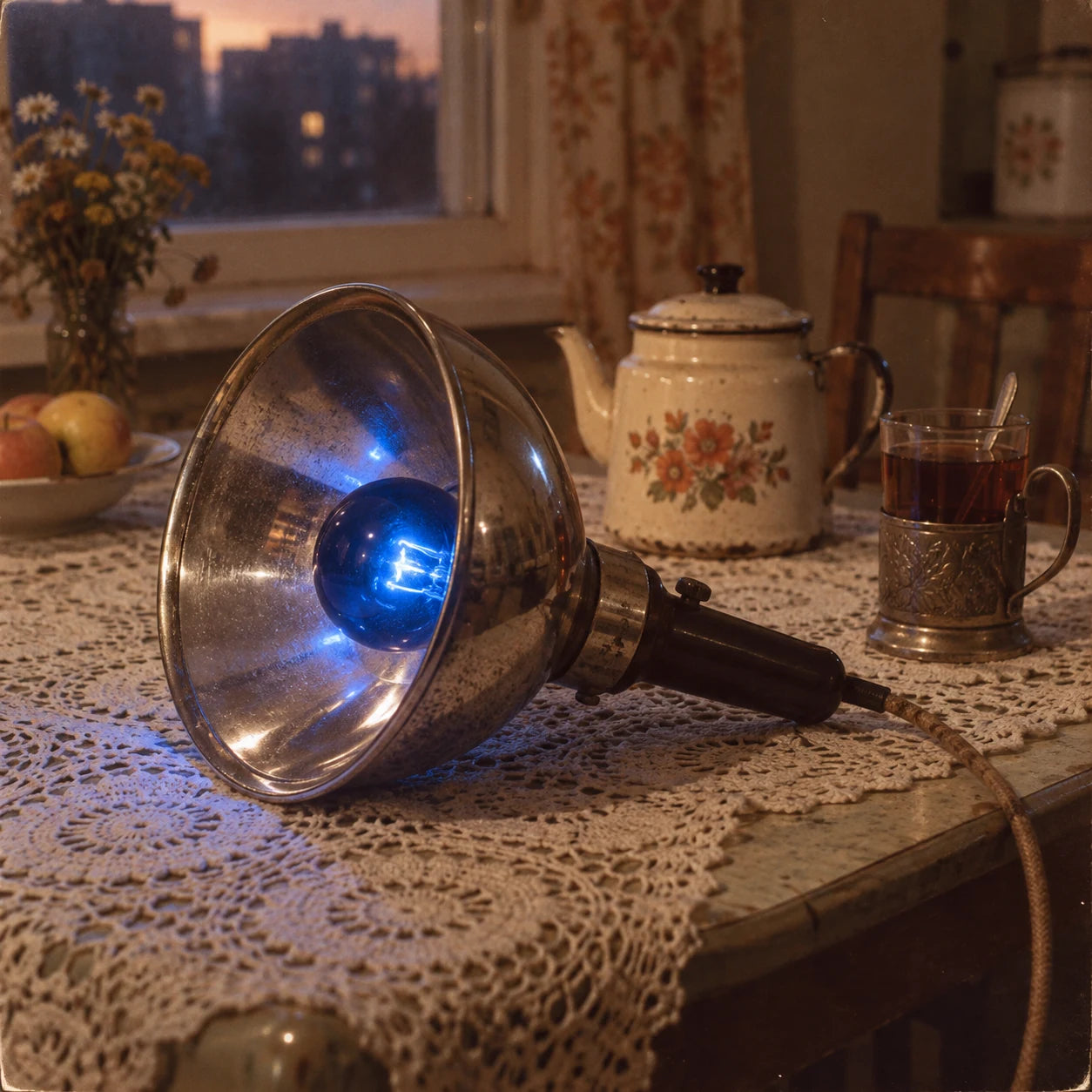
In 1891, a Russian military doctor named A. V. Minin is credited with inventing a very simple device: an ordinary light bulb with blue glass, set inside a polished metal reflector.
You plugged it in and held it close to whatever hurt. Its job was simple: gentle warmth.
The "blue lamp" became a fixture in homes across the Soviet Union. Families reached for it for all sorts of things, sore ears and stuffy, aching sinuses among them. Many people who grew up with it still remember it. One translated account on a Russian-language health site says simply: "The lamp of blue color is familiar from childhood."
Then modern drugs arrived, and the ritual faded.
Now, let's be honest about what that story is and isn't. Nobody ever proved the blue lamp cured anything, and we're not going to pretend otherwise.
But it tells you something true about people: when our noses feel blocked, we reach for warmth. It's the same instinct behind the hot washcloth over the face, the steamy shower, and leaning over a bowl of hot water with a towel over your head. Even Cochrane, the group that reviews medical evidence, notes that people keep using steam because of how much better it makes them feel.
Warmth on a stuffy nose isn't a new idea. It's one of the oldest comforts there is.
What's new is when you use it.
The Warm Wind-Down Method: 3 Steps, About 15 Minutes
Remember the key idea from earlier: stuffy nights are won or lost before your head hits the pillow.
The Warm Wind-Down Method is built around that. It has three parts, and each one does a different job.
Step 1: Stay upright.
Do your wind-down on the couch, in a chair, or propped up against the headboard. While you're sitting up, gravity is still on your side and the Pillow Effect hasn't started yet. You're doing your wind-down while breathing is at its easiest, instead of lying flat and waiting for your nose to close.
Step 2: 15 minutes of gentle warmth over your nose.
Warm the bridge of your nose, the spot where it feels most blocked, for about 15 minutes. Watch a show, read, scroll, talk. It feels good, it tells your body the day is over, and it gives your hands something to do other than reach for the bottle.
That last part matters more than it sounds. For a lot of people, the spray isn't just a product; it's a habit with a time and a place. The easiest way to change a habit is to put a better one in its spot.
Step 3: Go to bed head-up.
When you lie down, don't lie flat. Raising your head keeps it higher than your heart, which works with gravity instead of against it and eases the Pillow Effect itself. There's a right way and a wrong way to do this, though. Stacking three pillows bends your neck and usually slides out from under you by 2 a.m. That's why every order includes our free Head-Up Sleep Setup guide, which shows you how to do it properly.

Why all three? Because each one covers a gap the others leave.
- Sleeping head-up helps once you're in bed, but it gives you nothing for the restless half hour before, when the spray habit usually kicks in.
- Warmth feels wonderful, but on its own it doesn't change how you sleep.
- And none of it works if it feels like a chore, because you'll quit by Thursday.
Let's be straight about one thing. Fifteen minutes of warmth won't change your anatomy. Once you lie down, gravity still does what gravity does. What the wind-down changes is the half hour that decides how your night starts. You go to bed calm instead of already fighting your nose. You skip the reflex reach for the bottle. And you lie down head-up, which is the part that works on the Pillow Effect directly.
That's what "winning the night before you lie down" really means. Not magic. Just setting up the night on purpose, instead of letting it ambush you at 3 a.m.
The Problem With Doing It the Old-Fashioned Way
You could do Step 2 with a hot washcloth. People have for a hundred years.
Here's how that usually goes: you soak it, wring it out, lie back, and it's lukewarm in two minutes. So you get up and do it again. It drips into your ears. You have to hold it in place. By the third reheat, you've given up and gone to bed stuffy.
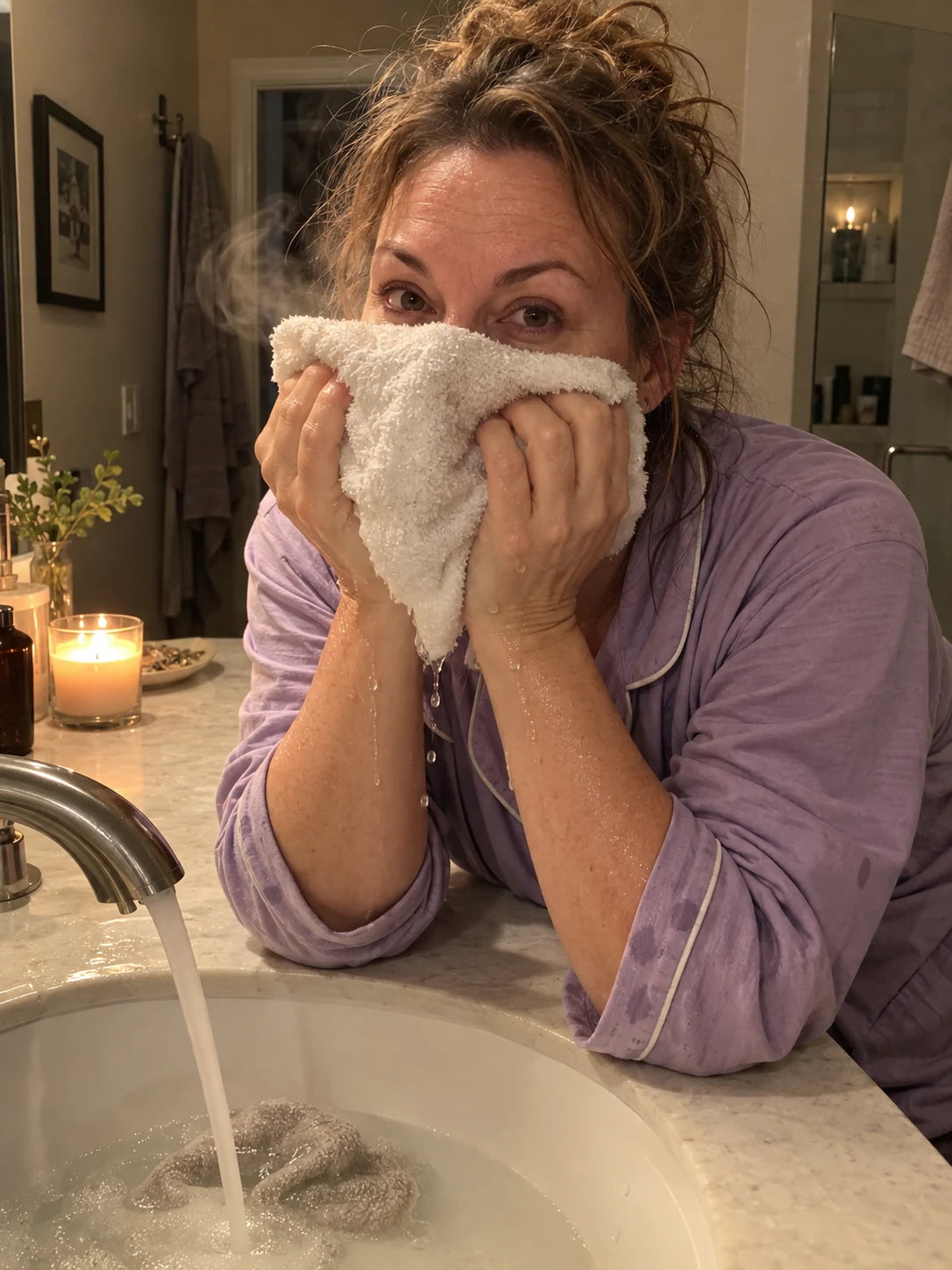
A routine only helps if you actually do it every night. So we designed something that makes Step 2 effortless.
Meet the Duskwell Wind-Down Band
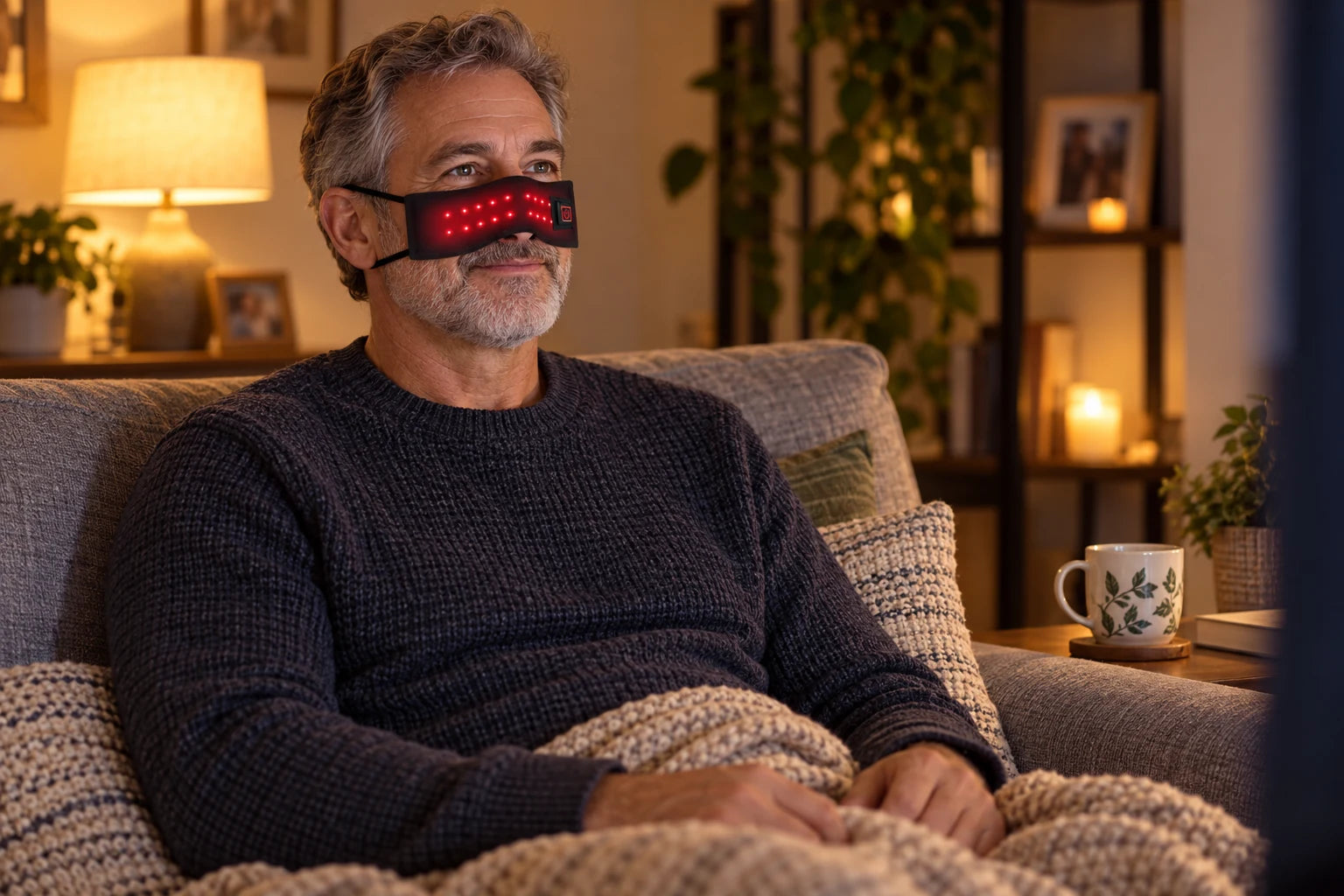
The Duskwell Wind-Down Band is a soft, cordless band that rests over the bridge of your nose and delivers gentle, steady warmth for your 15-minute wind-down.
- Cordless. A built-in rechargeable battery means no cable to trip over while you're wearing it. Charge it during the day, then sit wherever you like.
- No reheating, ever. No kettle, no microwave, no dripping washcloth. Press the button and it warms up on its own.
- Three heat levels. You choose how warm it gets.
- Made for a 15-minute session. Put it on at the start of a show, take it off before you head to bed. Tip: set a 15-minute timer on your phone.
- Soft red light over the bridge. Eighteen small red LEDs glow right where your nose feels most blocked. (More on what red light can and can't do in a moment.)
- Your nostrils stay clear. The band sits above them, so you breathe normally while you wear it.
- Adjustable ear loops that fit a wide range of face shapes and sizes.
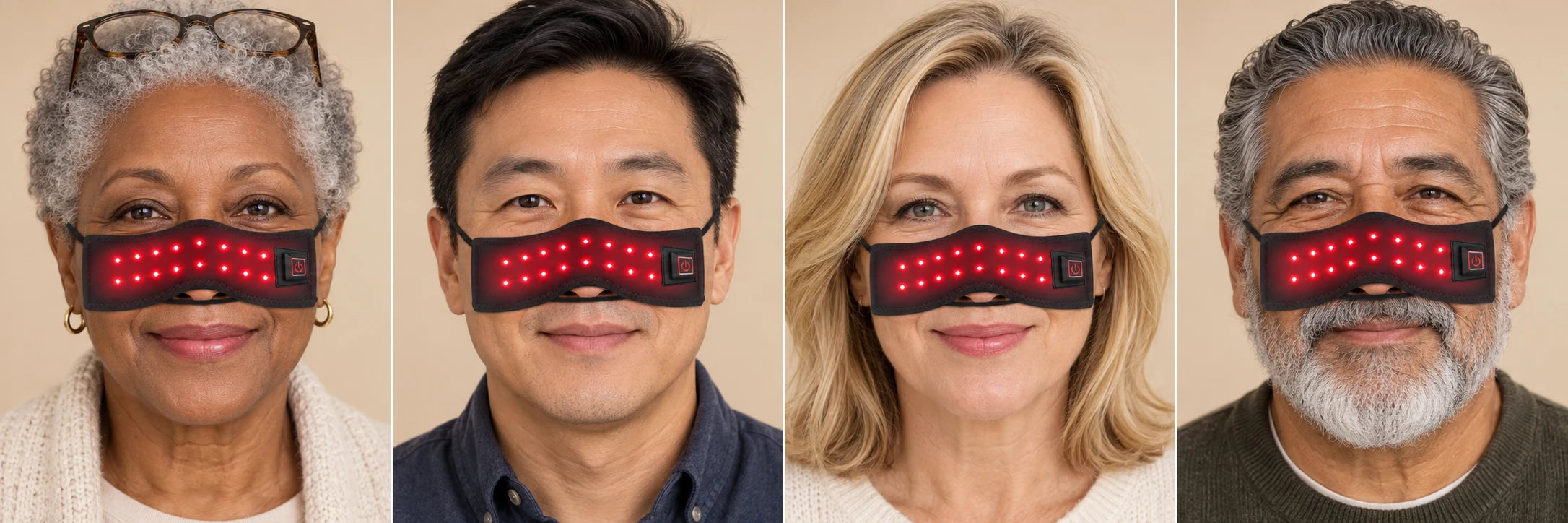
One thing it's not for: sleeping in. The band is for your wind-down, before you lie down. When your 15 minutes are up, switch it off, take it off, set up your pillow head-up, and turn out the light. That's the whole point of the Method: get ahead of the night, then let the night be.
"Won't I look ridiculous?" For 15 minutes, a little. You'll look like a sci-fi extra who wandered onto your couch. But you're at home, in your pajamas, at the end of the day. The only one who'll see it is whoever's sharing the couch, and they'll probably want a turn.
"How soon will I notice anything?" You'll feel the warmth shortly after switching it on. The rest is a routine, and routines take a little time. Give the full Method a week or two to settle in, and you have 60 nights to decide if it's for you.
See How the Duskwell Band Works →
How It Stacks Up
| Hot washcloth | Nightly decongestant spray | Basic heated nose pad | Duskwell Wind-Down Band | |
|---|---|---|---|---|
| Drug-free | ✓ | ✗ | ✓ | ✓ |
| Fine to use nightly, as directed | ✓ | ✗ (label says 3 days max) | Varies | ✓ |
| Stays warm, hands-free | ✗ | n/a | ✓ | ✓ |
| Cordless and rechargeable | n/a | n/a | Varies | ✓ |
| Comes with a step-by-step method | ✗ | ✗ | ✗ | ✓ Wind-Down + Head-Up Setup |
| 60-night guarantee + 1-year warranty | n/a | ✗ | Varies | ✓ |
Yes, you can find basic heated nose pads online for less, and premium sinus gadgets that run up to $169.99. Duskwell sits in between for a simple reason: you're not just getting a heater. You're getting the whole Method, the Head-Up Sleep Setup, and a guarantee long enough to actually find out if it fits your life.
What Duskwell Won't Do (We'd Rather You Hear It From Us)
You've been oversold before. So here's the honest version.
- It is not a medical treatment. It won't cure sinusitis, allergies, rhinitis, or a cold, and we'll never tell you it does.
- It won't blast your nose open in 30 seconds like a spray. That's not what it's for. It's a calming ritual that sets up your night, not a rescue at 3 a.m.
- It won't replace your medication. If you use a spray or any prescription regularly, keep your doctor in the loop. Duskwell is something you can try alongside their advice.
- Red light over the nose is not proven science. Studies on red light for the nose have shone the light inside the nose, and even there the results are mixed. We include the red light because it sits right on the spot that feels most blocked, and many people find the soft glow relaxing. That's the claim. Nothing more.
- You still might have rough nights. Bad pollen days, a cold, a dusty hotel room: some nights will be harder than others.
What it will do: give you a warm, calming, drug-free 15 minutes every evening, done upright, followed by a better way to sleep. A routine that feels this good is one you'll actually stick with. And the people it's built for are exactly the ones who are tired of fighting their nose at 3 a.m.
Why Start Now?
Because your stuffy season is probably already here, or close.
A study published in PNAS looked at pollen records from 60 stations across North America and found that since 1990, pollen seasons have grown about 20 days longer, with about 21% more pollen in the air. The biggest increases were in Texas and the Midwest.
On top of that, fall ragweed is in the air right now, and soon the heat comes on and indoor air dries out. For many people, this is when the 3 a.m. wake-ups start stacking up.
You don't have to wait for the worst night of the season to try something different.
Try It for 60 Nights. If It's Not for You, Send It Back.
We know what it's like to spend money on one more thing that ends up in a drawer. So we made trying Duskwell as close to risk-free as we can:
- 60-Night Wind-Down Guarantee. Use the Method every evening for up to 60 nights. If you don't love your new routine, send it back for a full refund.
- 1-Year Warranty. If your band stops working, we'll replace it.
- Free shipping on every order.
Every order also includes, free:
- 📘 The Head-Up Sleep Setup guide: how to sleep head-up the right way, without a wall of pillows.
- 📗 Grandma's Warm Remedies: time-tested, drug-free comfort rituals for stuffy seasons.
Choose your option:
- 1 Band: $39.90
- 2 Bands: $67.90 (save $11.90, $33.95 each) ← Best for couples. One for you and one for your partner, or one by the couch and one in your travel bag.
- 3 Bands: $83.90 (save $35.80, $27.97 each) ← Best value. For the whole household, or to give one to someone who's been stuck on the spray too.
See the Duskwell Wind-Down Band →
Tonight Could Look Different
Picture it.
It's 9:45 p.m. You're on the couch with the band on, a soft warm glow over your nose, halfway through an episode. When the episode's first act ends, you switch it off and set it aside. You head to bed, settle in head-up, and turn out the light.

The bottle doesn't have to be the first thing you reach for anymore. Tonight, the first thing is fifteen warm minutes on the couch. And maybe, for once, the person next to you sleeps through too.
No miracle. No chemicals. Just you, getting ahead of the night instead of fighting it after it starts.
Your nose isn't broken. It's the Pillow Effect. And now you know what to do about it.